
Now that the prequel trilogy is complete, comics are one of the outlets left to provide Star Wars fans with new stories. However, with over 15 years of continuity comes an inherent degree of complexity, history and as such inaccessibility to new readers. Dark Horse is currently in the throws of re-vamping its Star Wars line and re-packaging and re-publishing its more popular stories from the 90s. In light of this Fractal Matter is here to guide you through the maze that is the Star Wars Expanded Universe and to highlight the highs and lows of Dark Horse’s forays into that galaxy far far away.
Star Wars comics have a history as long as the films themselves, having been published initially in 1977 by Marvel. At this time they provided an extremely valuable boost of income to the flagging publisher, but they also did something else. They established the seeds of what has become known to Star Wars fans as The Expanded Universe or EU. The Star Wars EU>/i> was the one of the first, and certainly the most enduring, spin-offs from a motion picture or TV series. The history of the EU is somewhat convoluted. Marvel ceased producing Star Wars comics in 1986, at a time when Star Wars mania was beginning to die. At this time the EU began to flag but was kept afloat by the production of rpg materials by West End Games, and by the meagre number of die hard fans who bought them. Then in the early 90s the EU moved back to the mainstream with Bantam’s publication of Heir To The Empire by Timothy Zahn. Around this same time the emergent Dark Horse comics saw an opportunity to pick up a licence that Marvel now had no use for, and began publishing Star Wars comics again.
All this would have been rather by the by had these three endeavours remained independent, but they didn’t. West End Games borrowed from both Bantam’s novels and Dark Horse’s comics to fuel their rpg materials and the writers of these comics and novels, seeing the opportunity to create something bigger than their own work, began to borrow back. The result was the formation of an infant universe, one that the fans latched onto with a passion, and in fact it was in fan circles that the term EU was first coined. Lucas Licensing having marked the fan obsession with continuity, and concerned to ensure no encroachment upon future work produced by Lucasfilm itself, began to more tightly control and monitor all Lucas Licensed fictional works. The aim was to produce a continuous timeline where no one piece of work contradicted or clashed with another. The result after over 15 years of publications has been largely successful with Lucas Inc eventually adopting and embracing the EU concept and terminology fully, to the point where it even has a section on the official Star Wars website these days.
Over the years the EU timeline has become longer and new time periods have been generated outside of movie continuity in order to facilitate more freedom in story telling. For ease of navigation it is broken down into several different time periods and it makes more sense to discuss the comics in relation to these periods than the chronology of our own universe…honest it does.
The Old Republic Era
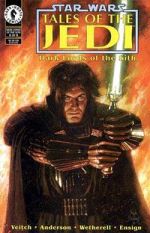
Set 4000 years prior to the original Star Wars movie Episode 4: A New Hope (ANH) this was initially the most obscure time period ever to non Star Wars fans. It is ironically now one of the most well known due to the enormous success of the Knights of The Old Republic video games released in 2003/4. It was created by Dark Horse themselves, together with writers Tom Veitch and Kevin J Anderson, in an effort to escape the continuity of the original trilogy characters and allow more freedom in storytelling. The initial series Tales of The Jedi was released in 1993/4 and told the story of two Jedi in training, Uliq Qel-Droma and Nomi Sunrider. Uliq’s story is one of traditional Jedi training and involvement in a war on the planet Onderon. Nomi’s on the other hand is of her training while on the run from the Hutt’s following her Jedi husband’s murder by them.
Both of these stories were well received by fans of the franchise and they lead directly into a second two issue mini-series The Freedon Nadd Uprising, which brought the two Jedi together with others as they quashed a Sith related uprising on Onderon. While these stories were of a good quality, and provide a valuable introduction to the characters and time period, they are really only a prologue to what follows directly in Dark Lords of the Sith and the The Sith War.
These two series were produced through 1994-6 and tell the story of the rise and fall of a new Sith empire. Fuelled by boredom and their discovery of sith texts a group of young aristocrats begin to build a new Sith empire. At the same time a Jedi apprentice Exar Kun, nurtured by the spirit of an ancient sith lord, falls deeply to the Dark Side and sits himself at the head of this new empire. Driven by personal tragedy and a desire to end the Sith, Uliq Qel-Droma goes undercover only to find himself slipping toward the dark side and becoming Kun’s apprentice and partner in crime. As the sith empire swells full blown war breaks out, and the Jedi are forced to face their old comrades in order to save themselves and the universe. These stories were well written, epic in scope and really caught the essence of the Star Wars universe. As such, while the art now looks slightly dated, they hold up incredibly well.
The two prequel series, The Golden Age of The Sith and The Fall of The Sith Empire, were set some 1000 years further into the past and detailed the rise and fall of the original Sith Empire. On the whole these stories were much less successful and, in my opinion, of nowhere near the same quality. In contrast an epilogue story Redemption, which followed Uliq’s return to the light, is one of the greatest Star Wars comics ever written. It captures the tragedy and the heroism of the character perfectly and represents the perfect bookend to this period of stories.
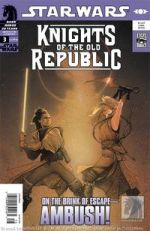
The Old Republic era was largely abandoned by Dark Horse from 1998, when Redemption was published, since the prequel films were being released and there was more fertile and profitable creative ground to be found in exploring the period surrounding them. However the end of the prequel films has necessitated a move back to other time periods, and the success of the Knights of The Old Republic video games has prompted Dark Horse to plunge back into the Old Republic era. As part of their ongoing revamp of the Star Wars line they are producing a new on-going series carrying the same name as the video games; canny marketing there. Although only 2 issues are out Knights of The Old Republic series is showing great promise. The writing seems solid and the initial story arc is quite gripping. The art, while not perfect is good, and seemed to improve between issues 1 and 2. On the whole things are looking good. In addition it seems very likely that Dark Horse will be re-packaging the old Tales of The Jedi series into one of their Omnibus editions, which will provide an excellent way for new readers to go back and appreciate these classic and incredibly well told stories.
Rise of The Empire Era
This is an era altogether more familiar to fans, and probably non-fans too. It runs from 1000 years before ANH through the prequel movies of recent years, up to the destruction of the Deathstar. The least well known series within this period is Jedi vs. Sith. It was revealed in the Episode I movie that the Sith had existed as a pair, master and apprentice, for several hundred years since the end of a long drawn out war with the Jedi, which ended in the Sith’s near destruction. Released shortly after Episode I, Jedi vs. Sith details the tail end of this 1000 year war and shows how the famous rule of two came into being. The writing was acceptable, and the art was fairly good, but the characters were not that engaging and the story itself seemed rather contrived. It boiled down to basically a needless exposition of a throw away line from the movie. As such it’s certainly not recommended reading for anyone but the hardcore Star Wars fan.
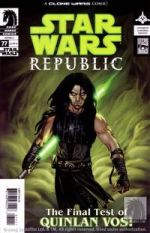
Apart from this series, the Rise of The Empire Era is dominated by one on-going series, Star Wars: Republic. Republic began life as the Star Wars on-going in 1998, when Dark Horse were re-vamping the Star Wars line to coincide with the release of Episode I. The series began with several 4 to 6 issue story arcs, which followed the jedi master Ki Adi Mundi as he discovers and trains his new apprentice A’Sharad Hett. While by no means bad, these stories relied on expanding background and bit part characters from the movie, and never really fired the fan base up. However issue 19 saw a new creative team of John Ostrander and Jan Duursema take over, and they pulled the series in an interesting direction. Rather than taking characters from the film they took a mystery jedi, Quninlan Vos, from issue 17 and gave him a story. He had lost his memory and become embroiled with a Devaronian mercenary, Ville. Vos’ character design was very much derived from Native Americans which gave him an immediate mysterious and spirutual appeal. He was a Jedi who was removed from the Jedi code due to his memory loss, he was on the edge, he was dangerous, he was interesting. Partnering him with Villie, for comedy effect, generated a pairing that immediately engaged the fan base and re-kindled that Star Wars magic once again. Quinlan Vos feature heavily in following story lines, as he struggled with finding himself after losing his memory, with retraining and with the lure of the dark side.
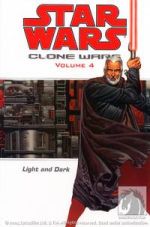
At issue 46, as the second prequel movie approached, the series became Star Wars: Republic rather than just Star Wars, and shortly after that began to detail the events of the Clone Wars that occurred after Episode II. These issues are some of the best Star Wars comics ever. They were part of the Clone Wars branding that occurred at the time across toy lines, comics, books and a cartoon series, and, like all good Star Wars stories, they had some unquantifiable something that made them more authentically Star Wars. The Clone Wars stories followed several Jedi including, Obi Wan and Anakin, as they played their roles in the war. They were expanded with a mini series Obsession, which detailed Obi Wan’s hunt for the renegade Sith Asaj Ventress, and several over-sized one shots focusing on individual Jedi such as Yoda and Mace Windu. However, it was the fan favourite Quinlan Vos who again supplied the best stories. Vos, undercover as a spy during the war, infiltrates Count Dooku’s inner circle, but, obsessed with finding the second Sith and ending the war, he is driven to new lengths and begins to plunge back toward the darkness he fought so hard to escape the first time.
Republic ended last month with issue 83. It has been the longest running Star Wars series since the original Marvel issues, and has supplied some of the most engaging stories. If you want to start somewhere with Star Wars comics you couldn’t do much better than starting with the Clone Wars trade paperbacks which have been beautifully packaged by Dark Horse, with standardised trade dress across the range. They are great alone, but when read together with the other earlier Republic issues, also traded, they gain an extra weight due to the journey of Quinlan Vos from darkness to, light, back into darkness and through to his final fate following the end of Episode III.
The Rebellion Era
Probably the most iconic era in the Star Wars universe it encompasses the three original Star Wars movies together with the period immediately before and after. This period is dominated by two series Star Wars: Empire/Rebellion and X-wing: Rogue Squadron.
Star Wars: Empire was launched in 2002 as a sister title to Republic. It began with a 4 issue story arc, which dealt with a group of high ranking imperial officers attempting to overthrow the new Emperor and Vader. It was a strong story, with solid art and a valuable glimpse into the characters of Vader and the Emperor, both of whom get little attention usually. Following this arc the series moved away from the imperial characters back to the familiar stars of the rebellion; Luke, Leia et al. Several story arcs followed detailing these characters movements before and after ANH. There was little consistency in art or writing teams during this time and in my opinion the series began to loose its footing. Despite this there were highlights. Issues 14, 19 and 31, all of which were standalone Vader focused issued were particularly strong both artistically and in terms of story. Issue 23, which focused on BoShek, a random background character from the Mos Eisley cantina, was a welcome light hearted comedy driven tale. The strongest stories of the series though have been issues 16-18, which contained the story arc To The Last Man, and the final issues 36-40, which contained the story arc The Wrong Side of The War. To The Last Man told the tale of Lt. Janek Sunber, a failed pilot now in the infantry, as he is forced to take over from his cowardly commanding officer and save his unit when they become besieged by native aliens on the planet Maridun. The Wrong Side of The War has us join Sunber a little later as his base is infiltrated by a group of rebels lead by his old friend Luke Skywalker. These stories were a cut above the rest of the series for the same reason as those featuring Quinlan Vos were, Sunber, whilst a complete unknown, was an engaging character. Trapped between duty and his own sense of right and wrong we follow him as he struggles to find his own place in the universe. Empire as a series ended with issue 40, but will pick up again in a new series Rebellion this month. I had the fortune to get an advance copy of the first issue and was pleased to see that the first story arc is one featuring Janek Sunber. Both the writing and art have taken a quantum leap forward in quality, and since it appears that the team responsible are assigned relatively permanently to the series I have high hopes for Rebellion.
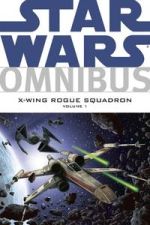
The second major series set in this time period, X-Wing: Rogue Squadron, was released in 1995, at a time, when the X-Wing video games were extremely popular. Written by author Michael A. Stackpole, who also wrote the majority of the X-wing novels, they detailed the adventures of the Rogue Squadron pilots in the period after Return of the Jedi. The stories were action packed and character driven, as most stories dealing with tight knit military units are. The highlight of the 35 issue run was those dealing with the Rogue’s imperial opposite, the 181st Tie Division, their leader Baron Fel and his defection from the Empire to Rogue Squadron. The X-wing: Rogue Squadron series ended with issue 35 but is now being re-visited in a related series X-wing: Rogue Leader, which began at the end of 2005 and takes place before the original series. Rogue Leader will be collected together with the first 8 issues of the Rogue Squadron series in an omnibus in June. This omnibus collects 300 pages worth of comics for $25, and is labelled volume 1, suggesting Darkhorse intends to re-print the entire Rogue Squadron series in this manner, and possibly the other older series as well. If you’re looking to get into Star Wars comics then these new omnibus editions are going to be something to look out for.
In addition to these two on-going series there have been multiple mini-series set within this time period, notably Mara Jade: By The Emperor’s Hand. Mara Jade was created by Timothy Zahn in his series of Star Wars novels, and has proved one of the most popular characters ever to come out of the Expanded Universe. By The Emperor’s Hand was a 6 issue mini-series detailing the fate of Mara Jade after the death of the Emperor. While not incredible by any means it was an entertaining story and one of the few appearances of Mara outside the novels, and in a visual medium.
The New Republic Era
This era runs from the end of the X-wing novels up until 25 years after ANH and is the one that has generated the bulk of Expanded Universe material, because it is the one utilised by at least half of the Star Wars novels; perhaps a subject for another day. There has never been an on-going comic series set within this period of time, but there have been several extremely good mini-series, the most important of which was undoubtedly Dark Empire.
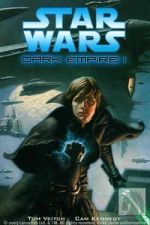
Dark Empire was a six issue series published between 1991 and 1992, written by Tom Veitch and illustrated by Cam Kennedy. It was the first Star Wars series released by Dark Horse, and it was hugely successful. From the first issue where a black clad Luke steps out from behind a rock and brings down an AT-AT using only the force you know this is going to be something special. Dark Empire tells the story of the Emperor’s resurrection into cloned bodies he prepared before his death. Yes I know it sounds ludicrous but if you suspend your disbelief then it does work. Luke becomes convinced the only way to bring the Emperor down is to join him and take him down from the inside. Dark Empire then is a story of a son following his father’s path into the Dark side and out again. The writing was epic, the art was very dark and exactly fit the mood of the piece, and the covers by Dave Dorman remain some of my favourite comic book covers ever. If you only read one Star Wars comic this really should be it. Dark Empire was followed by a sequel, the originally named Dark Empire II, which told of Luke’s continued battle against the Emperor and his quest to rebuild the Jedi order. While not terrible Dark Empire II felt a bit unnecessary and never quite hit the same rhythm as its big brother. Unlike Dark Empire II the final series in the trilogy Empire’s End was terrible. Cut by Dark Horse from a planned 6 issues to a meagre 2, it was rushed, poorly thought out and, to be honest, best forgotten.
A second series Crimson Empire, published between 1997-1998, succeeded where the Dark Empire sequels had failed, and showed that there was life left in the New Republic time period yet. Crimson Empire is set immediately after Empire’s End and tells the story of the imperial, or crimson, guards once their Emperor is dead. Carnor Jax, first among the guards kills his brethren and begins a quest to claim the now vacant imperial throne. One guard, Carnor Jax’s only peer, Kir Kanos survives and swears vengeance. The story follows Kanos on his quest, as he is forced to join with rebels to work his way to Jax. While good, it is not the main story that makes this series a cut above the rest. Rather it is the flashbacks that give us insight into the training of the guards and as such into the character of the Emperor himself, and the 12 page fight between Jax and Kanos at the end of the final issue, which make this such a good read. Much like Dark Empire Dark Horse pushed their luck by publishing a sequel Crimson Empire II, which while not as awful as Empire’s End was by no means good.
As well as these two series, Dark Horse published graphic novel versions of the hugely popular Timothy Zahn novels, Heir to the Empire, Dark Force Rising and The Last Command. There was also a fairly mediocre mini-series Jedi Academy: Leviathan set in the new Jedi academy formed by Luke, and a 4 issue mini-series Union, which showed the wedding of Luke to Mara Jade. Union is quite a nice story for fans of the Expanded Universe novels because it has a lot of charcters from those novels shown for the first time in a visiual medium, which allowed for a kind of “Where’s Wally” spot the cameo game whilst reading. For non-novel readers I can’t help feeling it would have all been a bit confusing.
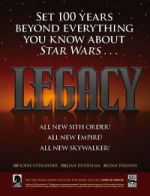
There are two further time periods in the Expanded Universe. The first of these The New Jedi Order Era is filled by a series of 24 novels published between 1999 and 2003. It runs from 25-30 years after the end of ANH and was never used by Dark Horse in their comics. The second period, The Legacy of the Force Era, follows immediately after and effectively shifts the focus of the Expanded Universe away from Luke, Leia et al, who at 50 something years old are pushing retirement age for intergalactic adventurers, and onto their children, all of whom are Jedi. It is the setting for the current group of novels being published by Bantam/DelRey. It is also the setting for a new on-going Dark Horse series to be launched later this year called Star Wars: Legacy. Legacy will be created by John Ostrander and Jan Dursema, the same pairing that brought the best out of the Republic on-going series. It will be set 140 years after Star Wars: A New Hope, which, like Knights of the Old Republic, clears the writers of any continuity created by either the films, books or comics previously created and leaves them to put their own stamp on the Star Wars universe. There are few details about the series beyond the inclusion of a descendent of Luke Skywalker, a new Sith Order and a new Empire; in all fairness though that’s probably enough to be getting on with. There has been mixed feelings about this series among fans, I for one though am pretty optimistic that Ostrander and Duursema can deliver the goods.
Well that about wraps it up. While not exhaustive by any means, this review should hopefully have given you an idea of what each of the periods in the Star Wars timeline has to offer, and which stories will be the best for you. So next time you’re in your local comic shop take a look at the Star Wars trades and think about journeying to that galaxy far far away. It really is worth the trip.
 Having just finished a PhD in Immunology Ross is currently pursuing a career as the most over qualified barman in the Midlands. He lives in Birmingham where he reads comics, spends too much money on music, clutters up his girlfriends house and attempts to learn Portuguese.