
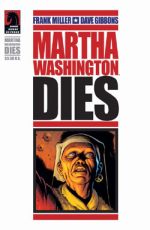
With the announcement that Frank Miller and Dave Gibbons had re-united to bring us a further and potentially final instalment of the Martha Washington saga in Martha Washington Dies (published by Dark Horse on July 11th) , it seemed like an appropriate moment to dig through those long boxes and reflect on the character’s story to date.
Martha Washington first hit the news stands in 1990 with the publication of Give Me Liberty, a four issue prestige format series by Frank Miller and Dave Gibbons. Both writer and artist came with impressive pedigrees on the back of Dark Knight Returns and Watchmen respectively.
Since then Miller and Gibbons have collaborated to bring us the further adventures of Martha Washington in four sequels; Martha Washington Goes to War, Happy Birthday Martha Washington , Martha Washington Stranded in Space and Martha Washington Saves the World.
It may seem tame now, but in 1990 the introduction of Martha Washington as a black, female protagonist in a science fiction story told in prestige comic book form caused something of a stir. The first chapter of Give Me Liberty, ‘Homes and Gardens’ introduces us to a typically dystopian future, populated with a ghettoised and repressed population of poor Americans. The first chapter introduces our protagonist, Martha, named after the first first-lady, an army officer Moretti , a psychic girl called Raggy Ann and various supporting and background characters.
The story is quite dense and much of the context is provided in spoof magazine articles, TV news and government information posters. These are techniques which Miller has used to good effect before and they help move the story along without too much exposition and allows Miller room to breathe life into his main character so that when she goes from ghetto child to homeless crazy person to soldier the choices seem valid and convincing.
There are strong elements of social satire wrapped up inside the action and adventure and both the tone and the war between PAX (the US army of volunteers) and the Fat Boy Burger company in the Amazon jungle are reminiscent of Pat Mills & Carlos Ezquerra‘s work in the Crisis magazine story ‘Third World War’ (published in 1988).
The satirical tone continues in the second chapter ‘Travel & Entertainment’ with the action moving to space where Martha has to deal with the threat posed by the Aryan Thrust, a gay neo-Nazi faction who have taken control of a giant space laser with distinctly phallic overtones. The issue also introduces two characters who feature heavily in the continuing arc; Wasserstein – leader of the Apache Nation and modelled perhaps on Tim Truman’s Scout – and the Surgeon General – complete with cloned female nurse/warriors called the Valkyrie and an arsenal of nuclear weapons with which to launch surgical strikes.
Chapter Three ‘Health & Welfare’ is more of a character piece as Martha is brainwashed by the Surgeon General. Outside in the world-at-large, Moretti’s rise through the military ranks culminates in a coup (with heavy overtones of Shakespeare) that results in the break up of the USA as various factions declare ownership of land and secede from the Union.
The concluding chapter ‘Death and Taxes’ returns to a more overtly action adventure style as Martha escapes from the Surgeon General’s secure hospital and sets up a denouement with her arch-enemy Moretti in the jungles of the Amazon,
The end is satisfying and closes the arc started in book one, but leaves the USA in a splintered and degraded state that is picked up and expanded on in the subsequent story.
Dave Gibbons’s art is sublime throughout the 4 chapters of Give Me Liberty, as he renders technology, landscape and people with impeccable skill. He also uses a variety of panel compositions depending on the needs of the scene which help the story flow or focus at the right times.
The book is not however perfect and on reflection the utterly US centric vision of the future is emblematic of the cultural imperialism that seems to pervade much of the popular output from the USA. From the maps shown in the story one might think that the mainland USA was an island separated from Canada (which is never mentioned) and Central America, again unmentioned other than the supposition that Mexico has been absorbed into an expanded Union. Whether this is all part of a meta-satire by Frank Miller is impossible to say definitively, but I detected no evidence of it in my reading.
What Miller does do very effectively is draw upon cultural icons and ideas which had been swilling around in comic book culture for a few years before the publication of Give Me Liberty; the riffs on ‘Third World War’, ‘Scout’ and other stories are too obvious to be accidental but they don’t suggest a lack of ideas but instead an absorption of a cultural moment. Perhaps because of that, and the nature of such a near future satire, the story reads as a statement about its time, grounded very much on the state of the USA as a nation in the 1980’s and 90’s. On the other hand, Miller should indeed be applauded for hanging his story on the life of a young urban black girl who is tougher, smarter and more resourceful than anyone else in the book. Another aspect that doesn’t come across as particularly convincing or necessary in the story, though it is stated explicitly, is that Martha experiences this all while exceptionally young. The events pan out over the period 1995 to 2012 (though the bulk of the action takes place between 2010 and 2011 – when Martha is 15 to 16 years old).
The adventures of Martha Washington continued in 1994 with the publication, in five parts, of Martha Washington Goes to War. Many of the main characters from GML return as Martha continues to serve as a soldier in the PAX, helping a restored President Rexall reunite the fragmented states of America through military force.
The tone and style are still very much that of a military action adventure but with far fewer elements of satire thrown in (the balance was if anything the other way round in GML) and the character’s chronology begins to get stretched thin as Martha (still only 19) uses experimental Sci-Fi weaponry that has been recently developed on one hand and yet is unreliable due to poor maintenance on the other. The major premise is also more fanciful than the previous outing and without the heavy overtone of social satire it just reads as a little too far-fetched and cartoonish. To a degree, these issues are resolved with a major plot turn later in the story but overall this story is a slight disappointment after the very high quality of the original. None the less, Gibbons’ art work remains at a high standard, but there is a heavier use of 2 or 3 panel pages and none of the faux magazine article framing device which worked so well previously such that it just lacks the polish that raised the original so far above the norm.
1995 saw the publication of two on-shots Happy Birthday Martha Washington and Martha Washington Stranded in Space.
Happy Birthday contains four shorter stories all of which are pretty good and the last of which, ‘Insubordination’ is a cracker. It features a Captain America analogy, which amazingly, rather than detracting from the semi-serious satirical tone of the series manages to fit in to it while adding pathos as well.
Gibbons art is also exceptional; though it is in the first story ‘Collateral Damage’ that he best demonstrates his range of panel composition and character expression.
By contrast, Stranded in Space which contains two stories is a bit daffy. The first has Martha and one of the surviving Valkyrie clones as the crew of a space shuttle which goes through a portal to another universe. There they meet The Big Guy, another Frank Miller created character, and reflect on how awful their world is compared to his. In the second story, which acts as a prelude to Martha Washington Saves the World, the heroes get involved in what appears to be a bug-eyed Alien invasion.
The three part Martha Washington Saves the World was published in 1997 and until the announcement of Martha Washington Dies, was the last word on the subject.
The near utopia that emerged at the end of Goes to War is under threat from an artificial intelligence gone rogue but when Martha is dispatched on a scientific mission to Jupiter, she realises that the real problems may well be closer to home. The artwork is again of the highest calibre and supports the story. Sadly on this occasion the story is a little weaker than those that preceded it with rather too much reliance on sci-fi archetypes and cosmic events rather than utilising the established characters to push the tale along. It isn’t bad, but it’s a pale shadow of the original. Despite that, it ends well and closes in the tradition of <>strong>Alan Moore’s Ballad of Halo Jones with Martha setting out on further adventures which until now appeared never to be told .
Based on the opinion that the Martha Washington stories had seen a decline before they ended and compounded by the somewhat patchy output from Frank Miller over the last couple of years, it was therefore with no great expectations that I opened the 8 page preview of Martha Washington Dies.
However I was pleasantly surprised.
The pace is completely different and the story opens with a woman who looks like a great grand-daughter of Martha listening to an old woman dressed in quasi religious garb telling a story. The pages are, or appear to be scene setters for the main tale, but Gibbons’ art, in terms of both line work and composition, is still superb The first three opening pages are single panel drawings but the focus then changes and Gibbons uses complex but uncluttered composition to draw out the significant elements of the story and give a palpable sense of the religious awe that the 100 year old Martha has imbued in her audience.
Needless to say I am now dying to know more.
 John Davidson Despite working in IT for the last 20 years and collecting comics for even longer, he is married, has two young daughters and lives in Scotland. Ideally he spends his spare time reading and watching movies, but this is curtailed by the calls of child-rearing and part-time study, not to mention the 'call of the internet'.