Review by Alasdair Stuart
Written by Jonathan Lethem and Karl Rusnak
Art by Farel Dalrymple
Color by Paul Hornschmeier
Published by Marvel Comics
www.marvelcomics.com
There are, when it comes down to it, three basic elemental conversations in comics journalism. These conversations are like Banquo’s Ghost with splash pages, endlessly returning to the surface, endlessly going over the same points and endlessly reiterating the same conclusions over and over again. They are:
-How can we get more people to read comics?
-Is change the greatest enemy or the greatest friend comics could have?
-Why are superheroes so popular?
Now, that last one in particular, to quote one of the 20th century’s last great philosophers leads, quite regularly to a ‘can open, worms…EVERYWHERE’ moment as companies struggle to come up with new variations, fans endlessly complain about the tiniest changes to old characters (Or the horrific death of old characters if they’re DC fans) and the amount of capes on the ground just keeps growing.
With this in mind, Omega the Unknown does not start well. A ‘re-imagining’ of the cult series written by Steve Gerber and Mary Skrenes, illustrated by Jim Mooney and published thirty years ago, the series feels, at first blush, like nothing more than an exercise in unnecessary nostalgia. Matters aren’t helped by the reference to it being ‘A version of an unfinished dream by Steve Gerber, Mary Skrenes and Jim Mooney’ on the first page, a phrase which leads any reader paying attention to believe that they’re about to be swamped by twin tidal waves of nostalgia and pretension.
Its a genuinely pleasant surprise then to find that the series is quietly very impressive. Opening with the strange dichotomy of a superhero warming himself by a campfire, his crashed spaceship in the background, the series creates a surreal, dream-like setting from the get-go, which manages to both echo the original story for anyone who remembers it and still have an identity all of it’s own.
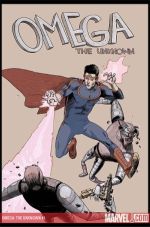
The story follows this mysterious, mute superhero as he battles a seemingly indestructible plague of robots and Alexander, an unusually calm, unusually bright boy who has been home schooled for years. On the way to his first day at school his parents’ car is run off the road, they’re critically injured and…Alexander’s life changes forever. To say anymore would spoil the genuinely unsettling feel of the series, as Omega, the superhero, and Alexander, the orphan find their stories converging in very unusual ways.
Farel Dalrymple’s clean lines are a perfect fit for the story and the kinetic force of the action scenes is all the more shocking for that style, balanced as they are by the moments of silence involving Omega and the unusually mannered conversations Alexander has with various characters. Lethem’s script is equally impressive, balancing these disparate plot threads with absolute confidence and creating a story which is deeply unusual, draws on the central themes and events of its predecessor and still stands up in its own right. There are some genuinely nightmarish moments here, from the final conversation Alexander has with part of his mother to The Mink, a deeply disturbing, narcissistic superhero and Lethem and Dalrymple ensure each one is as fascinating, and unsettling, as the last.
This is a highly unusual and extremely smart opening to a series and if you’re suffering from cape fatigue, then you should seriously consider checking it out. The combination of Lethem and Dalrymple, of next generation comic creators on a definitively retro property combines to make something intelligent, diverting and unique. Highly recommended.
Review by Adam Berry
Taking cult classic Marvel character Omega The Unknown and re-vitalising him for the newest generation of Comics fans might seem like the latest in a long line of poorly conceived promotions designed to lure unsuspecting fans into parting with their hard earned cash, but even if it is, is it such a bad thing? Fans today are on the whole a different breed to those variant cover munching Fanboys of the Nineties, or the relics of Silver Age that managed to avoid the dry years of the Seventies and Eighties. Today, what with the Internet and all, fans have a strong voice with which to yell their discord, and comics companies are as painfully aware of it as the fans themselves. No longer can a title merely cruise along by, coasting along on its former glories- it needs to constantly fight an impossible battle against years and years and years of continuity, plot-holes and bad writing to even make a dent in the market. There will always be a Spider-man. There will always be an X-Men (Uncanny or otherwise). There will even always be an Action Comics. But for titles like Omega The Unknown, Howard The Duck, Doctor Strange and The Power of Shazam!, which are not universally loved, which don’t have that ‘Je ne sais quois’ that catches the wave of the Zeitgeist, are always going to face the chop when the time inevitably comes for companies to trim their output and focus on other areas of promotion. So why even bother?
Well, when you have an award winning writer and two superb and stylistically dynamic artists on board for a project, it might not be wise to start them off with an already top selling book. Because if you’re wrong and sales plummet, then you’ve got a whole host of new problems to deal with (one of which might be looking for another PA to deal with all of the angry emails sent by fans of the previous creative team who feel they’ve been ripped off by having their beloved creators thrown off a book for some no-account newbies). But put these guys on a new book, or better yet an old book that’s been pretty much forgotten about and even if it bombs you don’t really lose out, do you? And if it’s a success then you have a whole new fanbase to build upon and bring along to the next, more high profile project (like a Bishop solo series or something).
In this first issue we’re introduced to a parallel story involving a young, socially backward teenager and his parents and a Superhero of sorts who seems to be fighting some kind of alien robots. A restrained use of pacing brings the two stories together in the most natural way, and we’re left wondering what kind of story we’ve begun reading. The plot is simple and of less importance than the story. It’s the characters we become interested in. Who is the guy with the van that tries to jump-start a robots head? Who is the kid and what/who are his parents? Who is the Superhero, if he even exists outside the boys mind? Is this the 616 regular Marvel Universe? Does it matter? The boys dialogue is as restrained and painful as the awkward uttering of a shy virgin, but that’s exactly what the story needs. No need for Spidey style quips and hijinks, this is a serious, ambulatory tale that is bigger than simple cops and robbers comic fiction.
The art uses a beautiful, subtle palette of browns, greys and soft blues, washing over the inks like the finest work of Chris Ware or Seth. Indeed, the two artists involved are both at the top of their game, both masters of their art and of their storytelling. Panels are full, yet given space to breathe whilst characters are drawn simply with little excess to their design. They just are; no need for masses of extraneous detail, the story gives us everything we need within its pacing and simplicity. The unique collaboration of these relatively new artists is an exciting prospect. Their previous work has gained some much-deserved critical acclaim. I can vouch for the importance (and genuine enjoyment) of Dalrymple’s Pop Gun War and of Hornschmeir’s Forlorn Funnies. Both are sad and tragic and funny and clever, without pretension or claims of genius. They are simply stories that need to be told, and are told extremely well with art sensibilities that only those cartoonists who have worked for themselves outside of the mainstream seem to be able to possess.
Omega the Unknown is unlikely to start a fire in the hearts and minds of collectors worldwide. People are unlikely to be scouring back issue boxes for old, ‘classic’ issues of the previous series. But if given a chance, maybe it’ll help some die-hard Marvel fans look at some other Indie work and give it a go- artists with a similar aesthetic and gift for storytelling, where the conflict comes from within, not from without.